

Every call, coached like your best closer.
You already pay for the leads. This is the layer that stops good ones being lost on the phone — every call scored, explained, and ready to coach by the next morning.
The problem
Good leads were being lost on the phone.
Every enquiry is paid for before the phone rings. Ads, listings, referrals, hours spent chasing a reply. Then good leads die on the call. A rushed opening. A question never asked. An objection answered badly.
A serious buyer goes quiet and nobody can say why. Almost no calls are ever listened to, so nobody sees it happen. Each customer costs more to win. Money wasted before the call. Hours wasted after it.
Coverage and capacity figures are current industry benchmarks for sales quality assurance, not a client-measured result.
Industry benchmarks
What teams report when coaching gets specific.
A rep told to build more rapport changes nothing. A rep shown the exact moment a customer went quiet changes the next call. Published benchmarks put a range on what that is worth.
What it is worth on your calls is a question only your calls can answer.
How it works
From a recorded call to a coaching note, by the next morning.
Nobody presses a button, and nobody picks which calls to check. Your reps make calls exactly as they do today. Every call is picked up, scored and written up on its own. The score, the evidence and the one thing to fix are waiting when the team comes in.
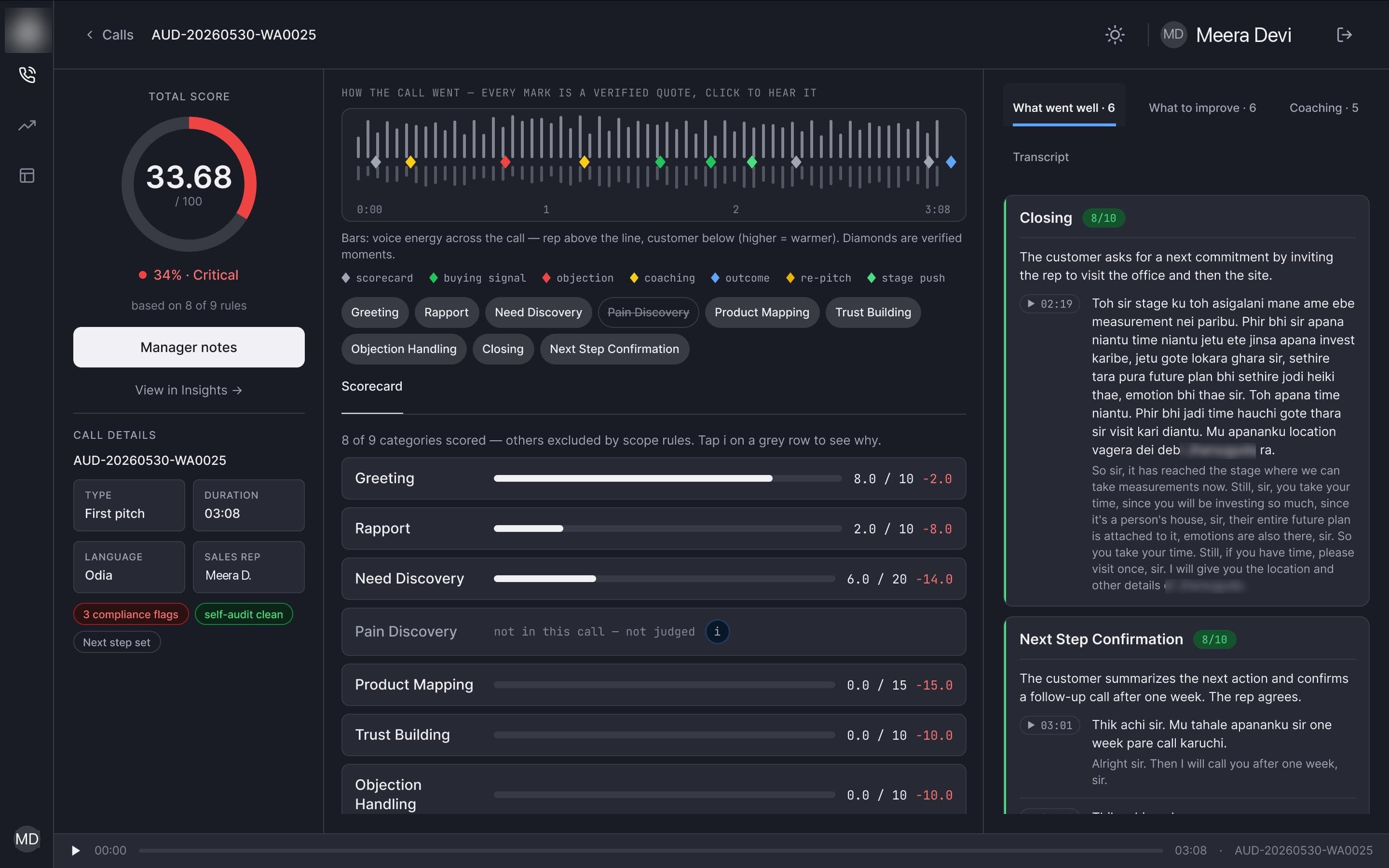
The scorecard. Every call scored across all parts, with the quote behind each mark.
It writes down every call, word for word
The transcript follows the conversation in the language it actually happened in. Everything else is built on that, so the coaching comes from the real call and not a rough English version of it.
It listens to the voice, not only the words
Tone, hesitation, urgency and frustration are read from the audio. You see the moment a customer went quiet, even when their words said everything was fine.
It marks every call in five parts
Opening, discovery, pitch, objection handling and close, each scored on its own. So you can tell whether deals are lost at the first question or the last one.
Every mark points to a timestamp
No score is given without a reason and the exact second it came from. A manager plays the clip instead of arguing about who remembers what.
It ends with one change, not a list of faults
Each call produces the single highest-impact fix, and the words to use instead. A rep can act on one line before the next call. Twenty criticisms change nothing.
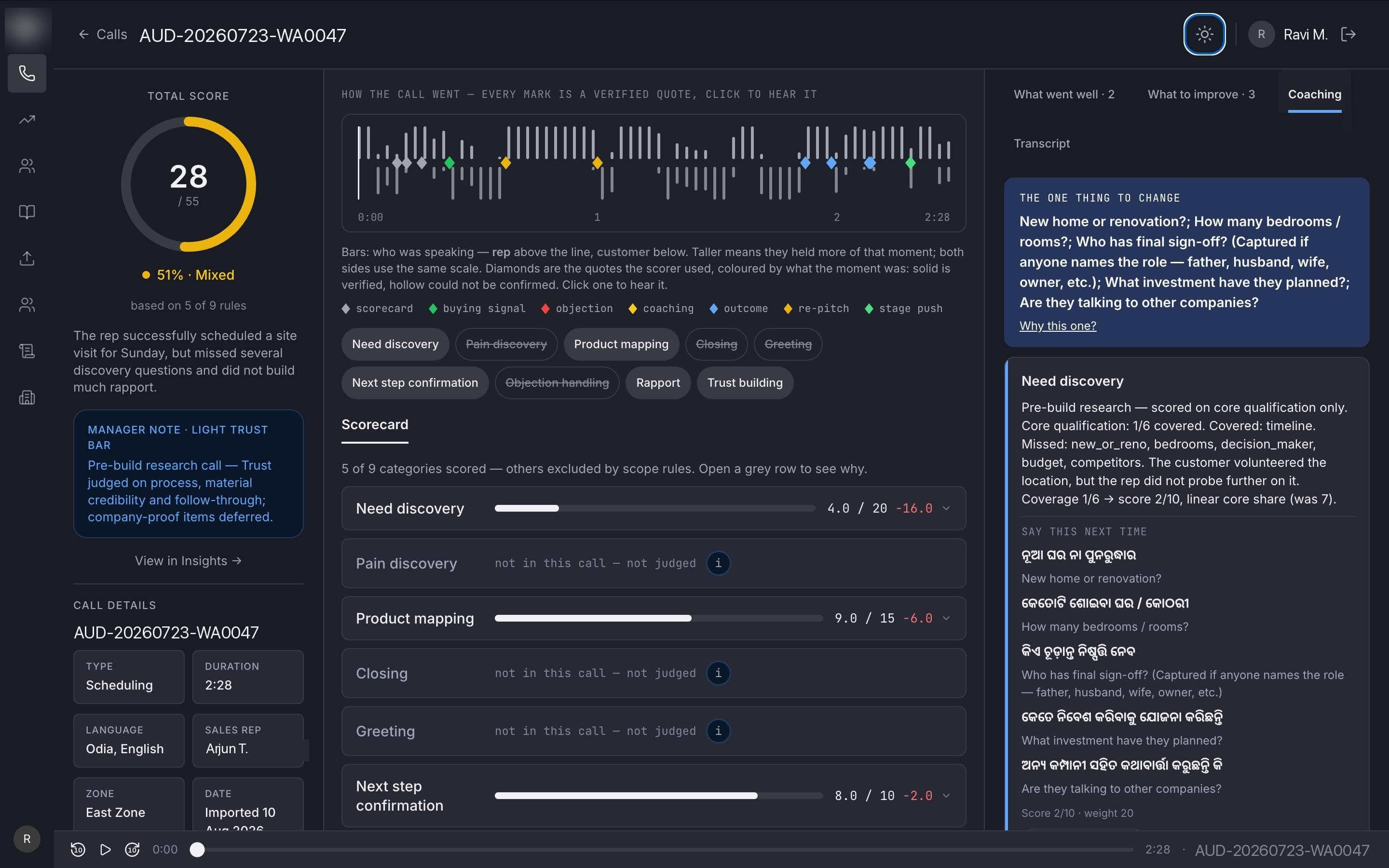
The one thing to change
The single change worth making next time, and the exact words to use.
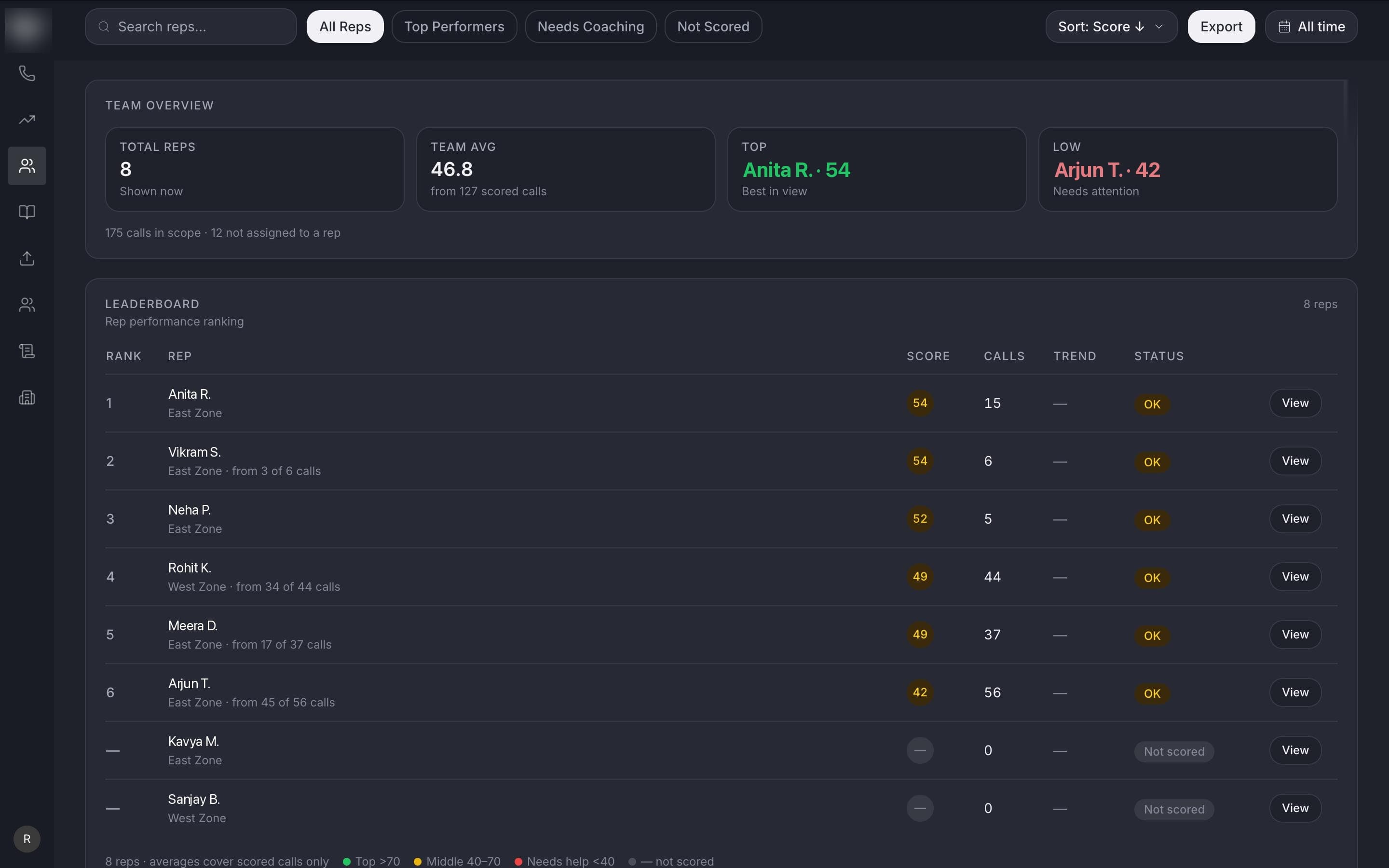
Where the team stands
Every rep ranked on every call they made, so coaching goes where it is needed.
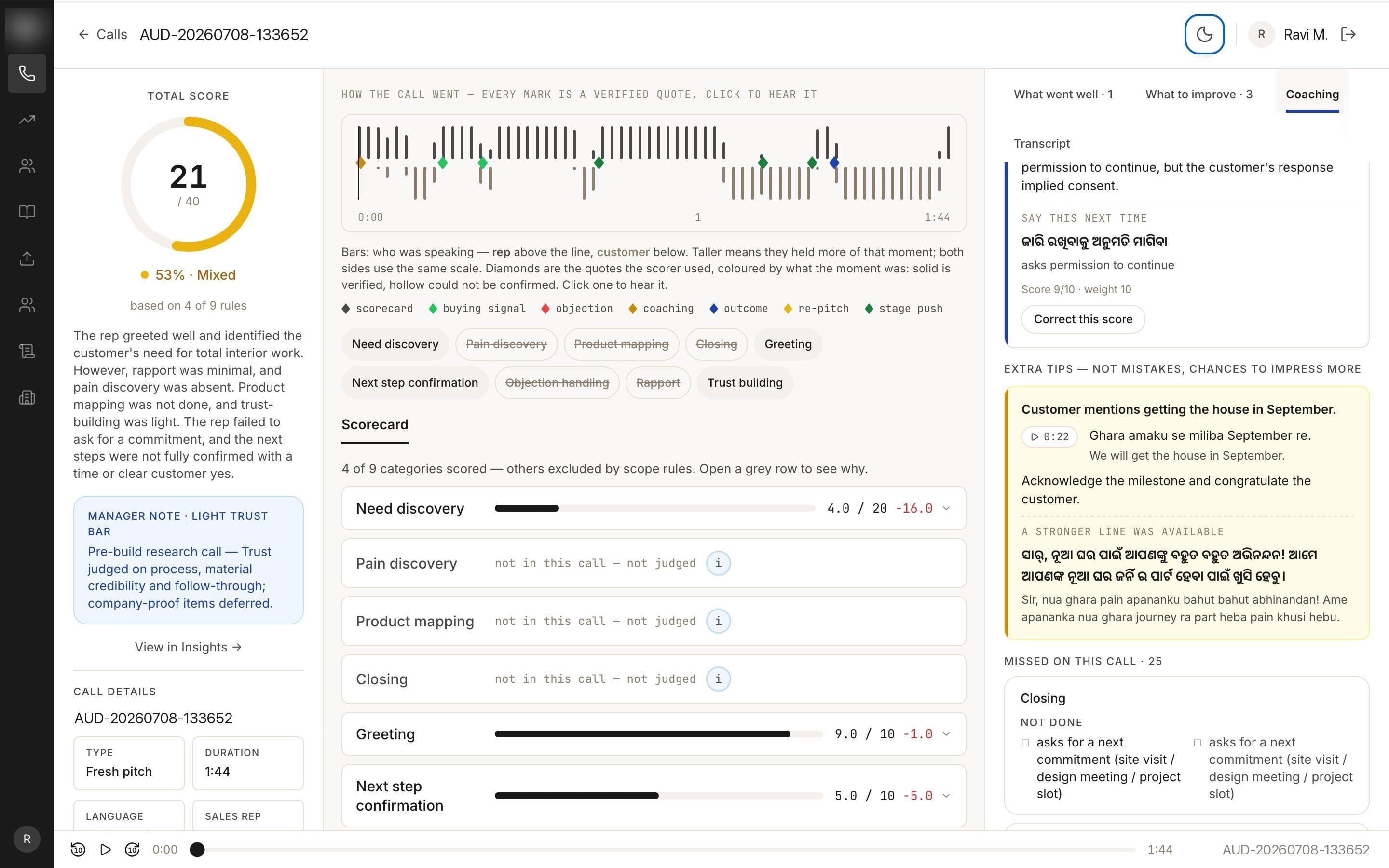
What was missed
The full transcript, the extra tips, and the commitments the rep never asked for.
Fewer good leads lost
The mistakes that kill a serious enquiry get found and fixed, instead of repeating unheard.
Senior time back
Reviewing stops being something a person has to ration. Managers coach instead of listening.
One standard for everyone
The whole team is coached against the same bar, not against different managers' memories.
Why this one fits
Nine things that make it work on an Indian sales floor.
Most call-analysis tools expect one language, spoken cleanly, reviewed by someone with hours to spare. Your sales floor works nothing like that.
Every call reviewed, not a sample
+
Every call is scored and explained, not the handful someone found time to hear.
Scored on selling, not on English
+
An accent or an imperfect sentence costs no marks, because reps are scored on how well they sold.
A fraction of the cost of manual review
+
Published benchmarks put manual review at roughly ₹40–60 a call, against ₹1–3 for AI scoring.
Every language your team sells in
+
Hindi, English, Odia and more, including the calls that switch language halfway through a sentence.
One view of the whole team
+
One screen shows every rep and where deals slip, at discovery, pitch or close, while the month is live.
Know who is really performing
+
Rankings built from every call, so incentives and promotions rest on evidence, not on who talks loudest.
Every rep gets their own playbook
+
Each rep opens their own scores, hears the moments behind them, and improves. No waiting for a manager.
It gets sharper the more you use it
+
It learns from every call scored and every correction your managers make, holding your standard, not a generic one.
Each manager sees their own team
+
Access follows your reporting lines: team leads see their team, heads see their region, you see everything.
The principle behind it
Kaizen for sales calls: every rep, one improvement at a time
Kaizen (改善) is Japanese for change for the better — kai, change; zen, good. English calls it continuous improvement: everyone takes part, from the boss to the newest hire, and the steps stay small and constant.
It is not old wisdom but modern management, built in post-war Japanese factories and carried worldwide by Masaaki Imai, who defined improvement as “involving everybody”. Working that way needs evidence, and that is what this platform gives you.
Plan — the standard
The five parts every call is marked against: opening, discovery, pitch, objection handling and close.
Do — the rep makes the call
Nothing changes about how your team works. They sell exactly as they do today.
Check — scored against the bar
Every call, not a sample. Each mark cites the exact second it came from.
Act — one change, then round again
One change to make on the very next call. The next score is the check on whether it worked.
Score, one change, next call, scored again — plan, do, check, act, once per call instead of once per quarter.
It involves everyone
Improvement belongs to everyone, so the same evidence on every call is open to three sets of eyes.
See it on one of your own calls.
Bring one recorded call. We run it through the platform while you watch, and show you what it heard: the score, the reason for it, and the moment in the call that reason points to. Hindi, English, Odia, or all three in one conversation.
No preparation and no slide deck. Thirty minutes, your call, and an honest look at where the scoring holds up and where it does not.