
Executive Summary
There's a physics-based game hidden inside our website. Not a chatbot easter egg. Not a gimmick. An actual playable experience — sitting right on our AI Capabilities page at radlabs.tech. We call it Neural Pathways. Built in a single day, it represents a core belief at Radlabs: interaction beats explanation every time.
The Challenge
Our team was designing the "Intelligent Systems" section of the site. Standard stuff — the kind of concentric-circle animation you've seen on every AI company's homepage. Orbital rings. Glowing nodes. Beautiful, forgettable.
Then someone asked a single question: "What if people could actually feel what our AI stack does — instead of just reading about it?" That question changed everything.
The Radlabs Approach
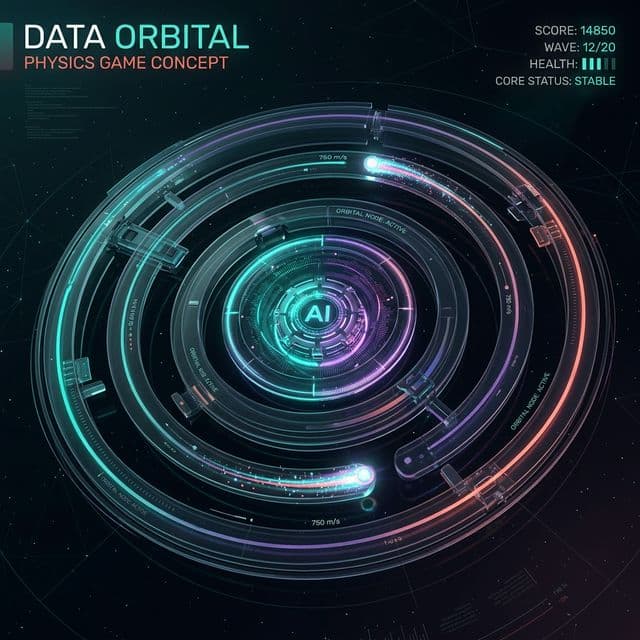
We didn't build Neural Pathways for engagement metrics or time-on-page stats. We built it to demonstrate our architecture visually. It's a game where you guide a data packet through 5 concentric rings to reach an AI core at the center, representing exactly how we build AI systems.
DATA
Every intelligent system starts with the right information. You must collect this node first.
LOGIC
Raw data without decision layers is just noise. The second required node in the system.
AI
Models without governance and execution are just expensive experiments. Only once all three are collected does the core activate.
Execution Timeline
The Question
Replacing a forgettable orbital rings animation with an interactive experience to feel the AI stack.
Translating Metaphor
Building mechanics that mirror reality: Data Pipelines → Logic Layers → Agentic Execution → Governance.
Shipped in a Day
Demonstrating that when your AI systems are designed well, speed is the standard, not the exception.
The Impact
| Metric | Baseline | Post-Radlabs |
|---|---|---|
| Time to Market | Idea | Shipped in 1 day |
| User Experience | Passive Reading | Active Interaction |
| Learning Curve | Complex Explanations | Intuitive Understanding |
| Engagement | Standard B2B | Playable Metaphor |
Built in a Day
From the question to a playable, shipped experience on our production website — one day. Not because we rushed it. Because we've built a process where speed isn't the exception. It's the standard. That's also the product pitch, buried in the process: when your AI systems are designed well — with clean data pipelines, smart logic layers, and fast execution — you ship faster. You iterate faster. You recover from mistakes faster.
The Mechanics Mirror the Reality
On desktop, your cursor creates a repulsion field. You push the packet through gaps in the rings — you can't drag it directly. You have to think about positioning. About timing. About where to apply pressure. On mobile, you physically tilt your phone. The ball responds to gravity. Each level gets harder. Fewer gaps. Narrower openings. Just like deploying AI in production. The first pass is easy. Anyone can spin up a model. But navigating real data pipelines, building decision layers that don't hallucinate under edge cases, and deploying with full governance and observability — that's where the rings close in.
Why We Built It
If you can't explain your AI stack to a 12-year-old with a game, you don't understand it well enough. Simplicity isn't dumbing down. It's proof of genuine clarity.
Interaction beats explanation. You can read about data pipelines. You can watch a video about logic layers. Or you can feel what happens when your packet can't reach the core without all three nodes in place. The felt experience sticks.
The best marketing doesn't feel like marketing. Neural Pathways doesn't ask you to schedule a demo. It just lets you play. And somewhere between the second and third ring, you start to understand how Radlabs thinks — before a single sales conversation happens.
Conclusion
The game proves the point by existing.
And if you're building AI systems that feel as stuck as a data packet in a closed ring — let's talk.
Radlabs Technologies — AI Partners. Limitless Vision. → sales@radlabs.tech